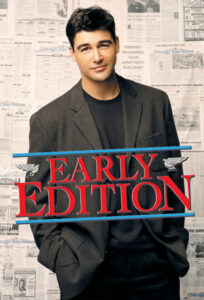
Early Edition
Cast & Key People

Our Review
One of the great what-ifs of nineties television, Early Edition ran four seasons on CBS from 1996 to 2000 on a premise you could fit on a napkin: a recently divorced Chicago stockbroker named Gary Hobson wakes up to find tomorrow’s edition of the Chicago Sun-Times on his doorstep, delivered by an orange tabby who materializes from nowhere, and he has twenty four hours to stop the tragedies the headlines predict. Kyle Chandler, two decades before Bloodline and the best father in football movies, carries all 90 episodes as a decent man doing the impossible errand. IMDb users rate it 7.6 out of 10 from 14K votes. There is no Rotten Tomatoes page for it, which tells you the critics moved on before the show found its rhythm.
The genius of the thing is how small it plays a huge premise. No one ever explains the cat. No shadowy agency collects the paper. Gary’s friend Marissa, a lawyer losing her sight while outworking every sighted colleague in the building, keeps telling him the paper is a gift for other people, and the show agrees with her. His broker buddy Chuck wants to gamble on the futures pages, and the scripts keep punishing him for it, which in nineties network TV is practically a thesis statement. Every week the mission is one life: a fire, a bus crash, a kid who should have stayed home. The stakes are a neighborhood, not the world, and the warmth is the point.
It also has real teeth when it wants them. An episode where Gary fails. A season two finale where the paper goes to someone worse. A late two parter revealing the paper’s previous recipient, played by Robert Donner, with Tess Harper turning up as Gary’s mother and Charles Durning as a judge who needs tomorrow today. The writing room included Jeff Pinkner and Carla Kettner, people who went on to Fringe and Grey’s Anatomy, and you can see the training ground.
Seven and a half out of ten, with the caveat the internet keeps shouting about: Early Edition cannot legally be streamed anywhere, full stop. No Paramount+ shelf, no rental storefronts, nothing. CBS made it and lost the will to repackage it, and a 2022 reboot announcement quietly died. The physical media exists, box sets from the show’s own era still surface secondhand, and the fandom has kept it alive on wishlists for two decades. If you find a copy, the Saturday night optimism plays better in 2026 than it deserved to in 1996. Ninety episodes, four seasons, one cat, zero explanations.